Discovering Community
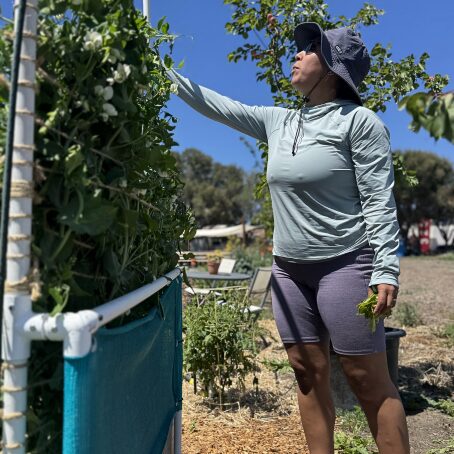
In East Palo Alto, access to fresh, affordable produce has never been a given. As grocery prices climb and food insecurity touches more families, the ability to grow your own food isn’t just a hobby– it’s a form of resilience. The East Palo Alto Community Garden at 230 Demeter Street exists at that intersection: a place where community members can feed themselves, share knowledge, and build something that belongs to all of them.
Community members like Sara Ordoñez, who was ready to join our network of gardeners when she heard about our new garden space opening up last June.
She grew up in Colombia, where fresh produce was always nearby, and began container gardening in Boston after the move there made her miss the taste of fresh produce. She carried her garden through rentals and relocations, from window sills to balconies to her first raised bed, until she landed in East Palo Alto.
“I was looking for community. I was looking for gardening. And I found this place.”
Since February, she’s harvested broccolini, radishes, peas, cilantro, parsley, chives, thyme, and oregano. Her marigolds and companion plants are laid out with purpose by each season. She’s already planning the summer transition, thinking about what the tomatoes will need, what the zucchini will attract.
But what she talks about most is what she’s learned from the people and experiences around her: from Juan showing her how to install the irrigation system and the vermicomposting workshop that reframed everything she thought she knew about compost and volunteer plants, to Community Garden Ambassador, L.A., sharing the “why” behind everything.
“That’s more than just learning to grow,” she said. “That’s nature, science, the cycle of life, everything.”
And from the garden, she’s grown a friendship with Balvina, who Sara describes simply: “If a green thumb exists, that’s her.”
Grief, Then Seeds of Hope
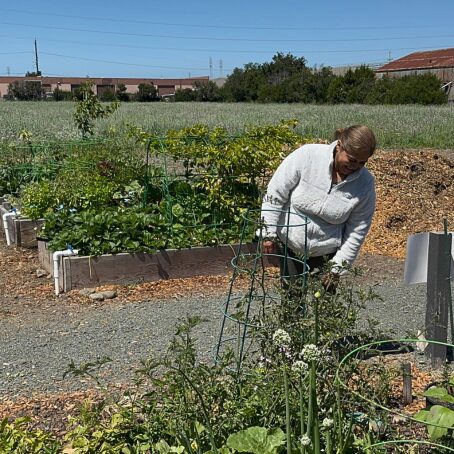
For Balvina, who’s been growing with Fresh Approach for more than a decade since our days at Collective Roots on Woodland Ave, the transition to the new garden came with grief. That garden had become something like an extension of her home: it was a short walk from where she lived, and she’d go whenever she had a free moment–not always to work, but sometimes just to sit on the bench and watch the butterflies.
“Para mí era más accesible, porque yo me iba caminando,” she said. “Tal vez nomás a sentarme ahí en la banca, o estar mirando las mariposas o las flores.”
But when she saw the new space at Demeter, which was immediately so much bigger than what they’d had before, her grief made room for hope. Last June, she was one of the community members nominated to participate in the opening ceremony and land blessing, holding the ribbon as the garden marked its new beginning. It was a fitting honor for someone who had tended the community with as much affection as she shows to the plants.
Today, Balvina comes to Demeter St with her husband. If they notice something that needs doing, they do it for the benefit of everyone. She’s brought cucumbers, planted tomatoes alongside fellow gardener Hilda, and eyes the remaining open plots the way she eyes seeds– full of possibility.
“Hay mucho espacio vacío — yo quiero sembrar en todo,” she said, laughing. “Tengo muchas plantas.”
There’s so much empty space, I want to plant in everything. I have so many plants.
In addition to the peace of tending to the garden, the economic reasons for growing food are now higher on her list of considerations. “For those of us who don’t have anywhere to plant, to grow our vegetables, especially now with the economy and the high prices, this space makes a very big difference.”
She talks about the garden’s value in the same breath as the economy. Tomatoes, she notes, are going for nearly $4. Her cilantro has been growing since the start, and she hasn’t bought any. She knows what she grows because she grew it– no fertilizers, no guesswork. And she’s already thinking about the families on the long waitlist, imagining what it would mean to grow food to give away.
Different Timelines, Same Soil
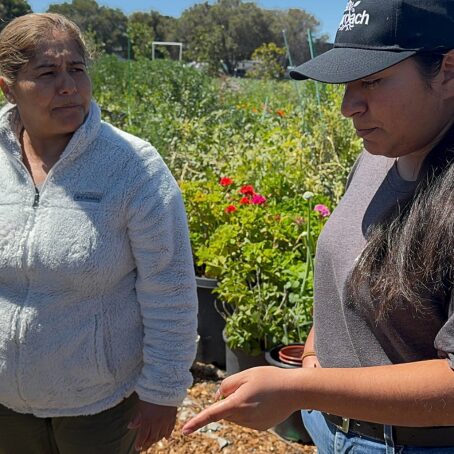
The two of them represent something the garden holds in abundance– different timelines, different origins, the same pull toward soil and community. Balvina’s roots in this program stretch back to when her now 18-year-old son was five years old, when she photographed him watering corn in the previous garden. Sara’s started with a closed gate and a leap of faith. The garden they’re both part of now didn’t exist a year and a half ago. It was an empty lot.
That’s what community resilience looks like in East Palo Alto. It looks like neighbors showing up for each other, sharing seeds and knowledge across languages and backgrounds. It looks like a waitlist that keeps growing because the need is real — and a community that keeps showing up to meet it. It looks like people feeding themselves and their families with food they grew, knowing exactly what went into it. And it looks like two women from different parts of the world, tending the same soil, watching the same butterflies.
If you’ve been curious about visiting the East Palo Alto Community Garden, getting your hands in the soil at one of our volunteer workdays, participating in one of our skill building workshops, and wanting to learn more about our community garden network, now is the time!